

Blog · Governance · 7 min read
Suing or Being Sued: Legal Action by a BC Strata Corporation
ManageStrata Team
October 31, 2026

The letter from a lawyer arrives on a Tuesday, addressed to the strata corporation, and three council members each assume someone else is handling it. By the time the council meets, nobody can find the minutes where the decision at the centre of the complaint was made, and the owner says they were never told it was coming.
What went wrong there was not the lawsuit. It was the record — a decision that was made but not written down clearly, and a demand that arrived before anyone was ready to answer it.
This post sets out what the Strata Property Act actually requires before a strata corporation sues, what happens when it is sued, who pays, and where the records fit in.
When a strata corporation can sue
The Act gives the strata corporation standing to sue as representative of all owners — except any owner being sued — about matters affecting the corporation, including the interpretation or application of the Act, regulations, bylaws or rules; common property or common assets; the use or enjoyment of a strata lot; and money owing, including money owing as a fine. That power comes from section 171.
The power is not the council's alone. Under s.171(2), the suit must be authorized by a resolution passed by a 3/4 vote at an annual or special general meeting, and under s.171(3) a person being sued is not an eligible voter for that resolution.
There is one carve-out worth knowing. Under s.171(4), authorization is not required for a Small Claims Act proceeding against an owner or other person to collect money owing — including money owing as a fine — if the strata has passed a bylaw dispensing with the need for authorization and the terms of that bylaw are met. Whether your corporation has such a bylaw is a question for your own registered bylaws, not an assumption; if you are unclear on how that differs from a rule, see Strata Bylaws vs Rules in BC.
A separate route exists where the matter affects only some strata lots. Under section 172, the corporation may sue on behalf of one or more owners if it first obtains those owners' written consent and the suit is authorized by a 3/4 vote at a general meeting.
What a "3/4 vote" actually means
A 3/4 vote is defined in section 1 as at least 3/4 of the votes cast by eligible voters present in person or by proxy at the time the vote is taken, excluding those who abstained. It is not 3/4 of all owners and not 3/4 of all strata lots, and abstentions do not count against the resolution.
One more step often gets missed. If a resolution requiring a 3/4 vote passes at a meeting where persons holding less than 50% of the corporation's votes supported it, section 51 applies: the strata must not act on it for one week (unless immediate action is needed for safety or to prevent significant loss or damage), and within that week persons holding at least 25% of the votes may demand by signed written notice a special general meeting to reconsider. That meeting must be held within 4 weeks of the demand, and the resolution is the first item on the agenda.
Before the strata sues an owner over money
Collection has its own mandatory step. Under section 112, before suing, beginning arbitration, or having the Civil Resolution Tribunal give an initiating notice to collect money from an owner or tenant, the strata must give at least 2 weeks' written notice demanding payment and indicating action may be taken if payment is not made in that period. The same 2 weeks' notice is required before registering a lien.
On liens, section 116 is specific about what can be secured: strata fees, a special levy, reimbursement of the cost of work referred to in section 85, and the strata lot's share of a judgment against the strata corporation. Subsection (3) says the lien does not apply where the amount is paid into court or held in trust under s.114, where satisfactory payment arrangements have been made, or where the amount owing is in respect of a fine or the costs of remedying a contravention. Fines are collectable, but not by lien. When the amount owing is received, the strata must remove the lien within one week by registering an Acknowledgement of Payment.
Questions councils actually ask
Can the council decide to sue on its own?
Not for a suit under s.171 or s.172 — those need a 3/4 vote at a general meeting. The single exception is the Small Claims collection carve-out in s.171(4), and only where the strata has passed a bylaw dispensing with authorization and its terms are met.
Can an owner sue the strata corporation?
Yes. Under section 163, the strata corporation may be sued as representative of the owners on any matter relating to common property, common assets, bylaws or rules, or involving an act or omission of the corporation — and s.163(2) says plainly that an owner may sue the strata corporation.
How is a lawsuit served on the strata?
By section 64, service of a notice of a court proceeding may only be effected by personal service on a council member, or by registered mail to the strata corporation at its most recent mailing address on file in the land title office — subject to another enactment or a court order. Keeping that land title address current matters more than most councils realise.
Who pays?
Under s.171(5) and (6), all owners except any being sued must contribute to the expense of suing, calculated in accordance with s.99(2) or s.100(1), leaving out the unit entitlement of a sued owner's lot. Under s.172, only the owners on whose behalf the suit is brought contribute. If there is a judgment against the corporation, section 166 makes it a judgment against all the owners, with each lot's share calculated as if it were a contribution to the operating and contingency reserve funds.
The owner on the other side of the file
Section 169 changes what an owner in litigation with the strata is entitled to. If the corporation sues or joins that owner, or the owner sues the corporation, that owner is not liable to contribute to legal costs a court or arbitrator orders the strata to pay; has no right to information or documents relating to the suit, including legal opinions kept under s.35(2)(h); and has no right to attend the portions of a general or council meeting where the suit is dealt with. Councils should apply that narrowly — it suspends access to the suit materials, not to the owner's ordinary records rights.
What a healthy strata does about it
Most litigation between a strata and its owners is an information problem that hardened. The decision was made but the reasoning never reached the minutes; the demand letter went out before the 2-week notice; the authorizing resolution was worded so loosely nobody could tell what was authorized.
Prevention here is clerical, and it is cheap:
- Write the resolution to be read later. Name the defendant, the subject matter and the scope, so the 3/4 vote clearly covers the suit actually filed.
- Keep the s.112 notice on file. A dated copy of the 2-week demand is the first thing anyone will ask for.
- Minute the decision, not just the outcome. Good AGM and council minutes are the record of why the corporation acted.
- Keep the records the Act requires. Section 35 lists what must be prepared and retained, including minutes with the results of votes, books of account, contracts, and decisions of a judge, arbitrator or the Civil Resolution Tribunal in proceedings the strata was party to.
- Check the land title mailing address so service under s.64 reaches someone.
That record belongs to the corporation, not to whoever is managing it this year — a point worth keeping in view whether you are self-managed or working with a manager. ManageStrata is built on that premise: the minutes, votes, documents and books stay with the strata when the council or the manager changes, and council can export a full copy at any time. For reading a pile of inherited documents before a dispute takes shape, SearchStrata can help a council analyse what is actually in them.
This article is general information about BC strata law, not legal advice; verify against the current Strata Property Act and Regulation or consult a BC strata lawyer.
General information, not legal advice. This article explains British Columbia strata law in general terms. The Strata Property Act and its regulations change over time and apply differently to each strata corporation. Confirm details against the current legislation or consult a qualified strata lawyer before acting.
Frequently asked questions
- Does a BC strata corporation need a 3/4 vote to sue an owner?
- Generally yes. Under s.171 of the Strata Property Act, a suit by the strata corporation as representative of all owners must be authorized by a 3/4 vote at an annual or special general meeting, and the person being sued is not an eligible voter on that resolution. The exception is s.171(4): a Small Claims Act proceeding to collect money owing, including a fine, does not need authorization if the strata has passed a bylaw dispensing with it and the bylaw's terms are met.
- Can a strata register a lien for unpaid fines?
- No. Section 116(3)(c) states that the lien provisions do not apply where the amount owing is in respect of a fine or the costs of remedying a contravention. Liens under s.116 cover strata fees, special levies, reimbursement of the cost of work referred to in s.85, and a strata lot's share of a judgment against the corporation. Fines may still be pursued as money owing, but not secured by a Certificate of Lien.
- What happens if a 3/4 vote to sue passes with only a small turnout?
- Section 51 applies where a resolution requiring a 3/4 vote passes with the support of persons holding less than 50% of the corporation's votes. The strata must not act on it for one week unless immediate action is necessary for safety or to prevent significant loss or damage. Within that week, persons holding at least 25% of the votes may demand in signed writing a special general meeting to reconsider, which must be held within 4 weeks of the demand.
Keep reading
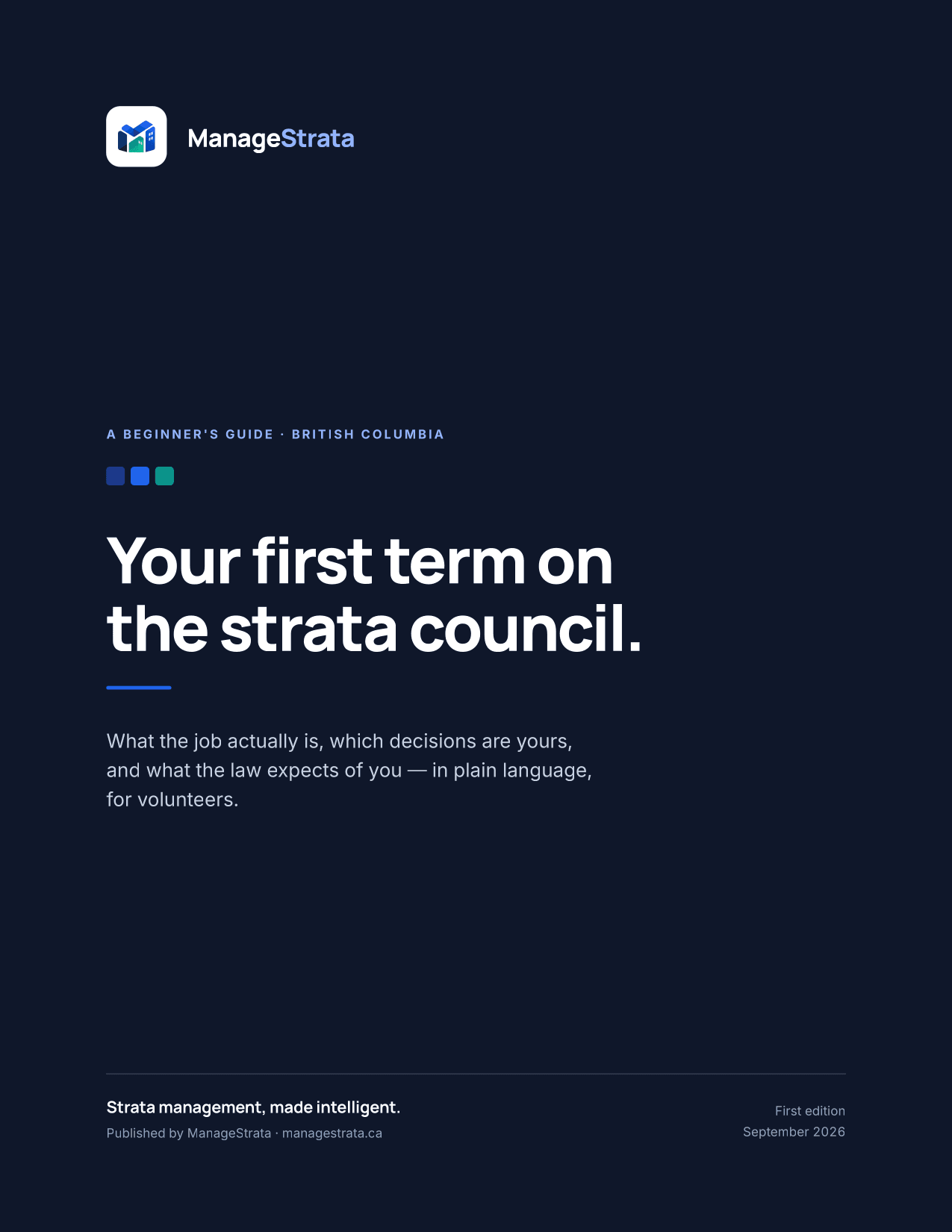
Free guide · 18 pages
Your first term on the strata council
New to the council, or handing the job to someone who is? Ten short chapters on what a BC council actually does, and the deadlines it can’t miss.
A few notes a year on running a strata
Deadlines that catch councils out, what changed in the rules, and what we shipped. Unsubscribe in one click, any time.
Run your strata with confidence
ManageStrata tracks your compliance deadlines, AGMs, and finances — with AI that drafts the work and you approve it. Self-managed or with a manager, the record stays with your corporation. Free up to 4 lots.
Start free