

Blog · Governance · 7 min read
Council Burnout: Keeping a BC Strata Running When Volunteers Are Tired
ManageStrata Team
November 7, 2026

It is 11 p.m. and the same council member is formatting minutes, chasing a second plumbing quote, and drafting a reply to an owner who says nobody told them about the elevator shutdown. At the last AGM, three seats were filled by acclamation because no one else stood.
The work didn't grow. It concentrated — into one person, whose knowledge of the building lives mostly in their own inbox. That is the real cost of strata council burnout: when the tired volunteer steps back, the record of why things were decided often goes quiet with them.
This post covers what the Act and the Standard Bylaws actually allow a council to do about workload — who is eligible to serve, what can be delegated, how meetings can be run, and what happens when seats sit empty.
Why the load lands on so few people
The number of people on council is set by your bylaws, not by a fixed figure in the Act (s.29). A council of seven and a council of three carry the same statutory duties — budgets, repairs, insurance, records, bylaw enforcement — so a smaller or half-attending council simply means each member carries more.
Two other things quietly add weight:
- Procedure takes time. Before a strata can fine someone, charge the cost of remedying a contravention, or deny use of a recreational facility, s.135 requires a complaint, written particulars to the owner or tenant, a reasonable opportunity to answer including a hearing if requested, and written notice of the decision as soon as feasible. Skipping steps is not a shortcut; it undoes the decision.
- Hearings have clocks. An owner or tenant may request a hearing in writing, and council must hold it within 4 weeks, with a written decision within one week afterward where the purpose was to seek a decision (s.34.1).
Widen the pool before you shrink the council
"No one wants to be on strata council" is sometimes really "no one eligible has been asked." Under s.28, council members may be owners, individuals representing corporate owners, and tenants who have been assigned the landlord's right to stand for council under s.147 (that assignment takes effect only once the landlord gives the strata written notice naming the tenant, the powers assigned, and the period). A strata may also pass a bylaw after its first AGM allowing other classes of people to sit on council, and may pass a bylaw barring a person from council in respect of a strata lot the corporation is entitled to lien under s.116(1).
In a strata with rented units, that tenant route is often the untapped half of the building.
Use the levers the Standard Bylaws already give you
If your strata has not amended them, the Schedule of Standard Bylaws provides several ways to spread the work:
- Delegate (Bylaw 20). Council may delegate some or all of its powers and duties to council members or to people who are not on council. Spending authority must be delegated by resolution — either a specific amount for a specific purpose, or a general authority that sets a maximum amount and the purposes or conditions. Council may not delegate deciding whether someone contravened a bylaw, whether to fine and how much, or whether to deny access to a recreational facility.
- Meet electronically (Bylaw 17). Council meetings may be held by electronic means so long as everyone can communicate with each other, and members attending that way are deemed present in person — which matters for the quorum rule in Bylaw 16, where members must be present in person to be counted. Owners may attend council meetings as observers, except for the portions dealing with s.135 hearings or matters where their presence would unreasonably interfere with an individual's privacy.
- Keep meetings simple to call (Bylaw 14). Any council member may call a meeting on at least one week's notice stating the reason; the notice need not be in writing. Shorter notice is possible if all members consent in advance, or in an emergency where members consent or are unavailable after reasonable attempts to contact them. Council must inform owners about the meeting as soon as feasible after it is called.
- Decide cleanly (Bylaw 18). Decisions are made by a majority of council members present in person, the president may break a tie with a second vote unless there are only two strata lots, and all vote results must be recorded in the minutes.
Check your own registered bylaws first — a strata can amend these, and many have. If you are unsure whether a practice in your building comes from a bylaw or a rule, see Strata Bylaws vs Rules in BC.
Q&A: when seats are empty or members step away
What if a council member resigns or goes quiet? If a member resigns or is unwilling or unable to act for two or more months, the remaining members may appoint a replacement for the rest of the term — even if the absence leaves council without quorum — and the appointee may be any person eligible to sit on council (Standard Bylaw 12).
What if the entire council walks away? Standard Bylaw 12(4) lets persons holding at least 25% of the strata's votes hold a special general meeting to elect a new council, following the Act, regulations and bylaws on calling and holding meetings.
Can owners remove a council member who isn't participating? Unless all owners are on council, the strata may remove one or more council members by majority vote at an annual or special general meeting, and must then hold an election at that same meeting to replace them for the remainder of the term (Standard Bylaw 11).
If nobody will serve at all, what then? The Standard Bylaws don't solve that case. Options owners sometimes pursue — including asking the court to appoint an administrator — are worth putting to a BC strata lawyer rather than guessing at.
Do we have to hire a property manager? No. Nothing in the Strata Property Act requires one; a strata corporation may be self-managed by its elected council, may hire full management, or may buy limited services such as bookkeeping while council keeps the rest. It can change that mix later. If you are weighing it, How to Self-Manage a Strata in BC walks through what the job actually involves.
What a healthy strata does about it
Burnout is rarely cured by one person trying harder. It eases when the next volunteer can pick the job up without reconstructing it from scratch — which is a records problem as much as a people problem.
A strata that handles this well tends to:
- Write decisions down as they happen. Recorded votes and clear minutes mean a new member can read six months of context in an evening instead of interviewing their predecessor. Our guide to preparing AGM minutes covers the habits that make the rest easier.
- Give portfolios, not piles. Delegate maintenance, finance liaison and communications by resolution under Standard Bylaw 20, so no single inbox is the building's memory.
- Put the knowledge where the corporation can reach it. Documents, minutes, votes and books belong to the strata corporation, not to whoever is currently holding them. That is the idea behind ManageStrata: the council or the management company can change, and the record stays with the corporation, with a full export available at any time. For older archives nobody has time to read, tools like SearchStrata can run an AI analysis across years of strata documents to surface what a new council needs.
A council that leaves a readable record leaves the next one a shorter night.
This article is general information about BC strata law, not legal advice; verify against the current Strata Property Act and Regulation or consult a BC strata lawyer.
General information, not legal advice. This article explains British Columbia strata law in general terms. The Strata Property Act and its regulations change over time and apply differently to each strata corporation. Confirm details against the current legislation or consult a qualified strata lawyer before acting.
Frequently asked questions
- Can a tenant sit on our strata council?
- Yes, if the landlord has assigned that right. Section 28 of the Strata Property Act lists owners, individuals representing corporate owners, and tenants who have been assigned the landlord's right to stand for council under s.147 or s.148. Under s.147, the assignment is not effective until the landlord gives the strata corporation written notice naming the tenant, the powers and duties assigned, and the period the assignment covers. A strata may also pass a bylaw after its first AGM allowing other classes of people to serve.
- Can our council meet by video call and still have quorum?
- Under the Standard Bylaws, yes. Bylaw 17 lets council hold meetings by electronic means so long as all council members and other participants can communicate with each other, and members attending that way are deemed to be present in person — which satisfies Bylaw 16's requirement that members be present in person to be counted toward quorum. Check your own registered bylaws, since a strata may have amended these provisions.
- What can council delegate to a volunteer or contractor to reduce the workload?
- Standard Bylaw 20 allows council to delegate some or all of its powers and duties to council members or to non-members, and to revoke the delegation. Spending powers must be delegated by resolution that either authorises a specific amount for a specific purpose, or gives general authority with a maximum amount and the purposes or conditions for spending. Council cannot delegate deciding whether a person contravened a bylaw or rule, whether to fine them and how much, or whether to deny access to a recreational facility.
Keep reading
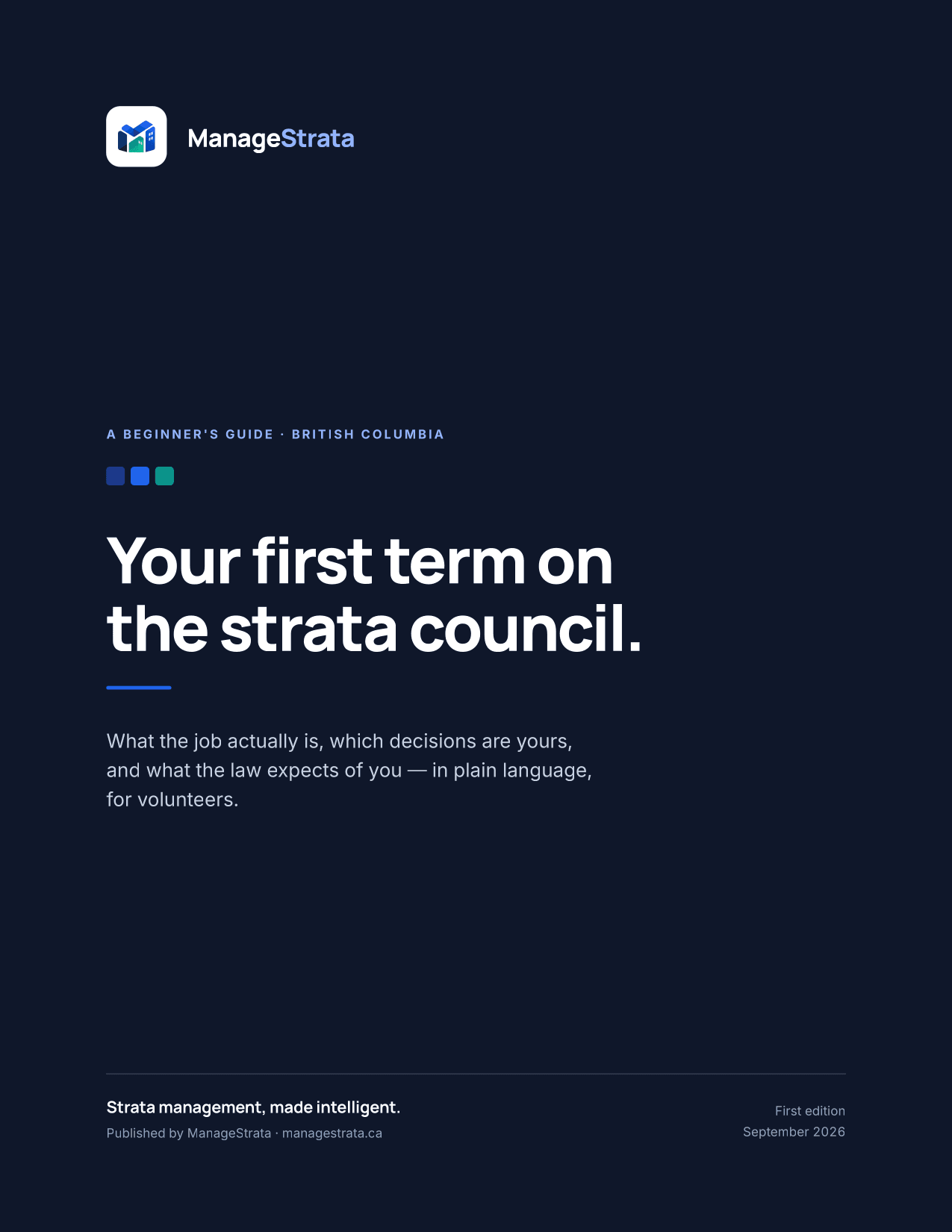
Free guide · 18 pages
Your first term on the strata council
New to the council, or handing the job to someone who is? Ten short chapters on what a BC council actually does, and the deadlines it can’t miss.
A few notes a year on running a strata
Deadlines that catch councils out, what changed in the rules, and what we shipped. Unsubscribe in one click, any time.
Run your strata with confidence
ManageStrata tracks your compliance deadlines, AGMs, and finances — with AI that drafts the work and you approve it. Self-managed or with a manager, the record stays with your corporation. Free up to 4 lots.
Start free