

Blog · Compliance · 6 min read
Getting a BC Strata Ready for Winter: Pipes, Gutters and Freeze-Ups
ManageStrata Team
November 16, 2026
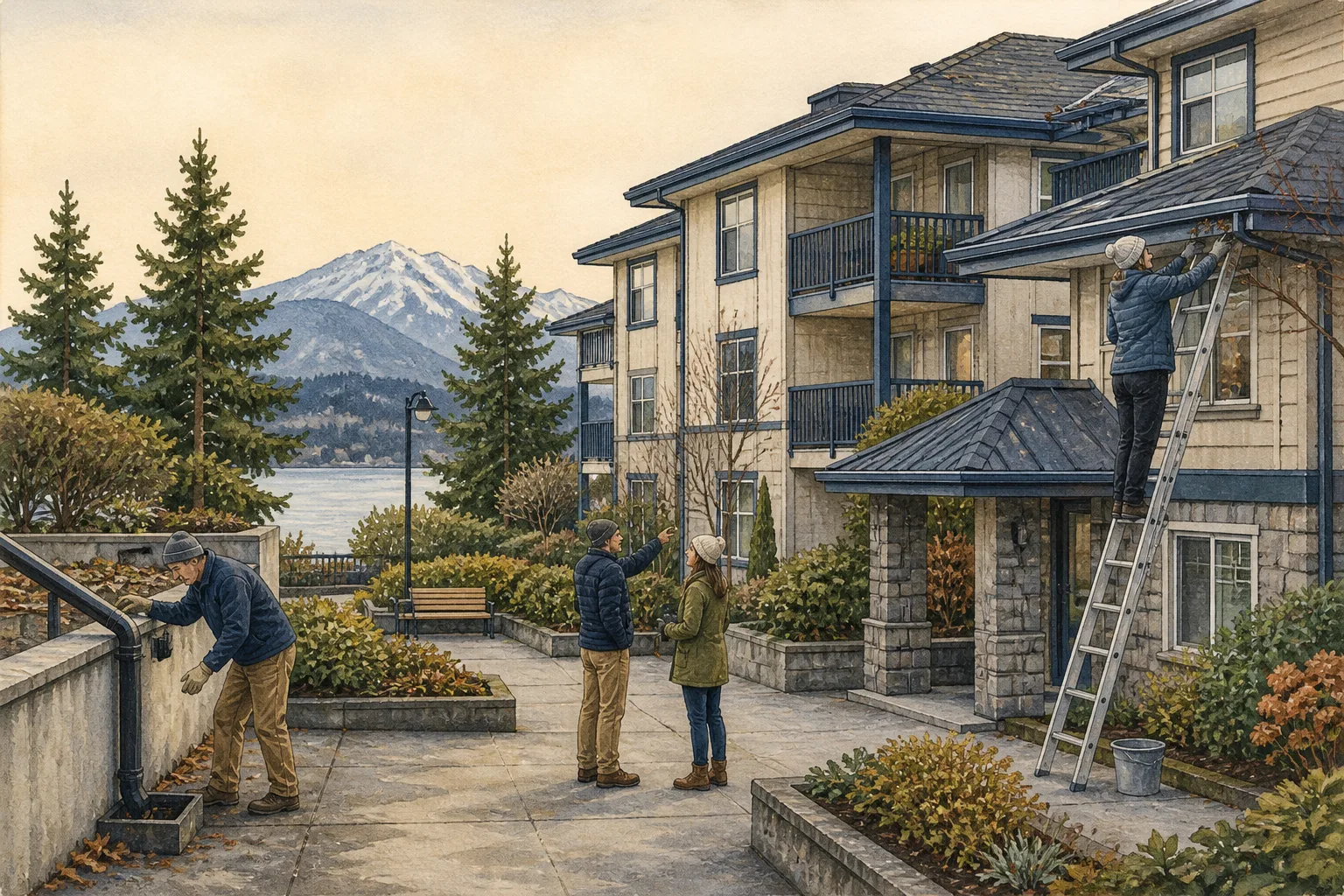
The first hard frost arrives on a Thursday night, and by Saturday an owner is standing in a hallway with a wet ceiling above her and a question nobody on council can answer: when was that line last checked? Somewhere in a binder, or in an inbox that belonged to a council member who moved away, is the note that would have told you. That gap — not the cold — is usually what turns a freeze-up into a claim.
This post sets out who is responsible for what under the Act and the Standard Bylaws, a practical strata winterization checklist, and how the money works if something bursts anyway.
Start with who is responsible for what
Under section 72 of the Strata Property Act, the strata corporation must repair and maintain common property and common assets. By bylaw it may make an owner responsible for limited common property that owner has the right to use, and it may take responsibility for specified portions of a strata lot.
If your strata still uses the Schedule of Standard Bylaws, the split is:
- Bylaw 2 — an owner repairs and maintains their strata lot, and any limited common property they have the use of, except where the bylaws make it the corporation's job.
- Bylaw 8 — the corporation repairs and maintains common assets and common property. For limited common property, that duty is restricted to work that in the ordinary course happens less often than once a year, plus the structure and exterior of a building, chimneys, stairs, balconies and other things attached to the exterior, exterior or common-property-facing doors, windows and skylights, and fences, railings and similar structures enclosing patios, balconies and yards. The same restricted list applies to strata lots in a plan that is not a bare land strata plan.
Pipes matter here. Under the definitions in section 1, pipes and ducts are common property when they sit inside a boundary floor, wall or ceiling, or when they run wholly or partly within a strata lot but are intended to serve another strata lot or the common property. A line that freezes "in someone's unit" is often not theirs at all.
Your registered bylaws may differ from the Standard Bylaws, so check what is actually filed in the Land Title Office before assigning a task. If nobody has read them end to end in years, a document tool such as SearchStrata can help council surface the maintenance and alteration clauses quickly, though the filed bylaws remain the authority.
A strata winterization checklist
Water and pipes
- Shut off and drain exterior hose bibs and irrigation lines; confirm backflow devices are protected.
- Identify every pipe running through an unheated space — parkades, crawlspaces, attics, storage rooms, exposed exterior walls — and confirm insulation or heat trace is in place and powered.
- Locate and label main and sectional shut-offs, and make sure at least two people know where they are.
- Ask owners heading south to leave heat on at a reasonable setting if their bylaws require it, and to arrange someone to check the unit.
Roofs, gutters and drainage
- Clear gutters, scuppers and roof drains of leaves before the first sustained rain.
- Check for ponding, lifted flashing and blocked overflow scuppers; ice forms where water sits.
- Clear catch basins and confirm perimeter drainage runs free.
Enclosures and heat
- Weather-seal common doors; check door closers that stick in the cold.
- Confirm parkade and corridor heaters, and any crawlspace heat, actually run.
Fire and life safety
- Freezing temperatures are hard on wet sprinkler systems in unheated areas. Each fire and life-safety system — alarms, sprinklers, extinguishers, emergency lighting, standpipes — must be inspected, tested and maintained at the interval the BC Fire Code sets for that system, and keeping them so is part of the corporation's s.72 duty. There is no single "annual fire inspection" of the whole building. Our post on fire and life-safety inspections breaks the intervals down.
Grounds and access
- Set your snow and ice response before it snows: who calls it, who salts, where supplies are. Keep accessible routes and entrances in the plan — see accessibility and the duty to accommodate.
Questions councils ask before the first freeze
An owner turned the heat off and a pipe burst. Can we fine them?
Only if their conduct actually contravenes a registered bylaw or rule, and only after the full procedure in s.135 of the Act: written particulars of the complaint, a reasonable opportunity to respond including a hearing if requested, and written notice of the decision as soon as feasible. The same applies before charging the cost of remedying a contravention. A fine imposed without those steps is void and cannot be fixed after the fact (Part 7).
Who pays the insurance deductible?
Two different outcomes. Under s.158(1), paying a deductible on a claim against the strata corporation's insurance is a common expense, contributed through strata fees. Under s.158(2), that does not limit the corporation's ability to sue an owner who is responsible for the loss to recover it — and that recovery is the owner's liability in full, not shared by unit entitlement. Responsibility is not automatic just because the water started in a particular strata lot (Part 9).
Do we need an owners' vote to pay that deductible?
No. Under s.158(3), strata corporation approval is not required for a special levy or a contingency reserve fund expenditure to cover a deductible the corporation must pay to repair or replace damaged property — unless it has decided not to repair under s.159. Separately, s.98 allows spending from either fund where there are reasonable grounds to believe an immediate expenditure is necessary to ensure safety or prevent significant loss or damage (Part 6).
What a healthy strata does about it
Winter rewards the councils that are ahead of things rather than behind them. The practical difference is written down:
- A dated seasonal task list with the name of who did each item, filed with the minutes rather than in one person's phone.
- Work orders and invoices attached to the asset they relate to, so next year's council starts where this one finished — our maintenance planning and work orders post covers the mechanics.
- A depreciation report that reflects reality. Regulation s.6.2 requires a 30-year inventory and evaluation covering the building's structure, exterior and roofs, and its systems including plumbing and fire protection — exactly the components that fail in a cold snap.
That record belongs to the corporation, not to whoever happens to be holding it. ManageStrata exists so the documents, minutes, votes and books stay with the strata when the council or the manager changes, and council can export a full copy at any time.
This article is general information about BC strata law, not legal advice; verify against the current Strata Property Act and Regulation or consult a BC strata lawyer.
General information, not legal advice. This article explains British Columbia strata law in general terms. The Strata Property Act and its regulations change over time and apply differently to each strata corporation. Confirm details against the current legislation or consult a qualified strata lawyer before acting.
Frequently asked questions
- Is the strata or the owner responsible for a frozen pipe in BC?
- It depends on where the pipe is and what your registered bylaws say. Under the definitions in s.1 of the Strata Property Act, pipes inside a boundary wall, floor or ceiling are common property, as are pipes running through a strata lot that are intended to serve another strata lot or the common property. Section 72 makes the corporation responsible for repairing and maintaining common property, though it may by bylaw shift responsibility for limited common property to the owner who uses it, or take on specified portions of a strata lot. Check the filed bylaws, not just the Standard Bylaws.
- Does a strata need an owners' vote to pay an insurance deductible after a winter flood?
- No. Under s.158(3) of the Act, strata corporation approval is not required for a special levy or a contingency reserve fund expenditure to cover a deductible the corporation must pay to repair or replace damaged property, unless it has decided not to repair under s.159. Separately, s.98 permits spending from either fund where there are reasonable grounds to believe an immediate expenditure is necessary to ensure safety or prevent significant loss or damage.
- Can a strata require owners to keep the heat on while they travel?
- Only if a registered bylaw or rule says so — the Standard Bylaws do not contain a minimum-temperature rule. Many strata corporations have adopted one. Before imposing a fine or charging the cost of remedying a contravention, the corporation must follow s.135: written particulars of the complaint, a reasonable opportunity to respond including a hearing if requested, and written notice of the decision as soon as feasible.
Keep reading

Free guide · 18 pages
Your first term on the strata council
New to the council, or handing the job to someone who is? Ten short chapters on what a BC council actually does, and the deadlines it can’t miss.
A few notes a year on running a strata
Deadlines that catch councils out, what changed in the rules, and what we shipped. Unsubscribe in one click, any time.
Run your strata with confidence
ManageStrata tracks your compliance deadlines, AGMs, and finances — with AI that drafts the work and you approve it. Self-managed or with a manager, the record stays with your corporation. Free up to 4 lots.
Start free