

Blog · Finance · 5 min read
Strata Special Levies in BC: A Council's Guide
ManageStrata Team
May 26, 2026

Sooner or later most councils face a project the operating fund cannot absorb and the contingency reserve fund cannot fully cover — a roof, a membrane, an elevator modernization. The tool the Strata Property Act gives you is the special levy. Owners often call it a "special assessment," but that phrase appears nowhere in BC legislation; the statutory term is special levy, and using it keeps your resolutions clean.
What a special levy is
Under section 108 of the Strata Property Act, a strata corporation may raise money from the owners by means of a special levy. It is approved by the owners at an annual or special general meeting — not by council alone — and the money is restricted to the purpose the owners approved.
Before reaching for a levy, check the alternatives. Spending from the contingency reserve fund needs a 3/4 vote in most cases, but only a majority vote in several specified situations, including repair, maintenance or replacement recommended in the most current depreciation report (Province of BC — the contingency reserve fund). A depreciation report that clearly recommends the work can therefore change which threshold you need — one more reason to know how to read your depreciation report.
There is also a narrow exception for insurance deductibles: strata corporation approval is not required for a special levy or CRF expenditure to cover a deductible the strata must pay to repair or replace damaged property, unless the strata has decided not to repair or replace (Province of BC — strata corporation insurance).
The vote: 3/4 or unanimous depends on how you split it
This is the distinction councils most often get wrong.
- If each strata lot's share is calculated under sections 99, 100 or 195 — in practice, by unit entitlement — the levy is approved by a 3/4 vote (s. 108(2)(a)).
- If the strata divides the levy "in another way that establishes a fair division of expenses for that particular levy," the levy requires a unanimous vote (s. 108(2)(b)).
A "3/4 vote" means at least 3/4 of the votes cast by eligible voters present in person or by proxy when the vote is taken, excluding abstentions (s. 1 definitions). It is not 3/4 of all owners, and abstentions do not count against the resolution. A "unanimous vote" is a different animal: all the votes of all eligible voters in the corporation, present or not — which is why creative cost-splitting formulas so often fail.
One nuance worth knowing: if your strata has taken responsibility by bylaw under s. 72(3) for specified portions of some but not all strata lots, Regulation s. 6.5 provides that a special levy for repairing those portions is shared only among the lots it relates to, prorated by their unit entitlement. Regulation s. 11.3 does the same within a section. Because that formula operates for the purposes of s. 99, it stays on the 3/4-vote track.
What the resolution must contain
Section 108(3) requires the resolution to set out all of:
- the purpose of the levy;
- the total amount;
- the method used to determine each strata lot's share;
- the dollar amount of each strata lot's share; and
- the date each payment or instalment is due.
Draft it in full and send it with the notice package. General-meeting notice must be at least two weeks, and notice sent by email, mail or fax is conclusively deemed received four days after it is sent — so an emailed package should go out roughly 18 days ahead (Province of BC — conducting a general meeting). Councils reviewing years of engineering reports and minutes to build the case sometimes use tools like SearchStrata for AI analysis of strata documents before drafting.
Questions councils ask
Can council impose a special levy on its own? No. Section 108 requires owner approval by resolution at an annual or special general meeting.
Who pays if a unit sells mid-levy? Section 109 splits it by conveyance date: the seller owes the portion payable before the strata lot is conveyed, the buyer owes the portion payable on or after. Future obligations under an approved levy are disclosed on the Form B Information Certificate, whose required attachments are the rules, the current budget and the most recent depreciation report (if any).
Can we charge a late fee? There is no statutory late fee. What the Act permits is interest, and only where a bylaw — or the resolution approving the levy — sets the rate, capped by the Strata Property Regulation at 10% per annum compounded annually. Section 108(4.2) confirms that interest is not a fine and forms part of the levy for lien purposes under s. 116 (Part 6). See also collecting strata fee arrears.
What if it passes narrowly? Section 51 applies where a 3/4-vote resolution passes with persons holding less than 50% of the corporation's votes. The strata must not act on it for one week (absent reasonable grounds that immediate action is needed for safety or to prevent significant loss or damage), and owners holding at least 25% of the votes may demand a special general meeting to reconsider, to be held within four weeks. It can only be reconsidered once.
Handling the money
Section 108(4) requires the strata to account for levy funds separately, invest them in investments permitted by the regulations or insured accounts with BC savings institutions, spend them only on the approved purpose, and keep owners informed about the expenditure. Surplus funds are returned to owners in proportion to what each strata lot contributed; if no owner would receive more than $100, the excess may be deposited in the CRF.
Tracking instalments lot by lot, issuing receipts and reporting progress is bookkeeping discipline — the kind self-managed councils handle in ManageStrata alongside their annual budget work.
This article is general information about BC strata law, not legal advice; verify against the current Strata Property Act and Regulation or consult a BC strata lawyer.
General information, not legal advice. This article explains British Columbia strata law in general terms. The Strata Property Act and its regulations change over time and apply differently to each strata corporation. Confirm details against the current legislation or consult a qualified strata lawyer before acting.
Frequently asked questions
- Does every strata special levy in BC need a 3/4 vote?
- No. Section 108(2) sets two paths. If each strata lot's share is calculated under sections 99, 100 or 195 — normally by unit entitlement — a 3/4 vote approves the levy. If the strata divides the levy in another way that it considers a fair division of expenses for that particular levy, the resolution requires a unanimous vote, meaning all the votes of all eligible voters in the corporation.
- What must the special levy resolution say?
- Section 108(3) requires the purpose of the levy, the total amount, the method used to determine each strata lot's share, the dollar amount of each lot's share, and the date the levy or each instalment is due. Missing any of these leaves the resolution vulnerable to challenge, so draft the full text and circulate it with the meeting notice.
- What happens to money left over after the project is finished?
- Under section 108(5), unused levy money must be paid back to each owner in proportion to the contribution made for that strata lot. Section 108(6) provides one exception: if no owner would be entitled to more than $100, the strata may deposit the excess in the contingency reserve fund instead.
Keep reading
Free guide · 18 pages
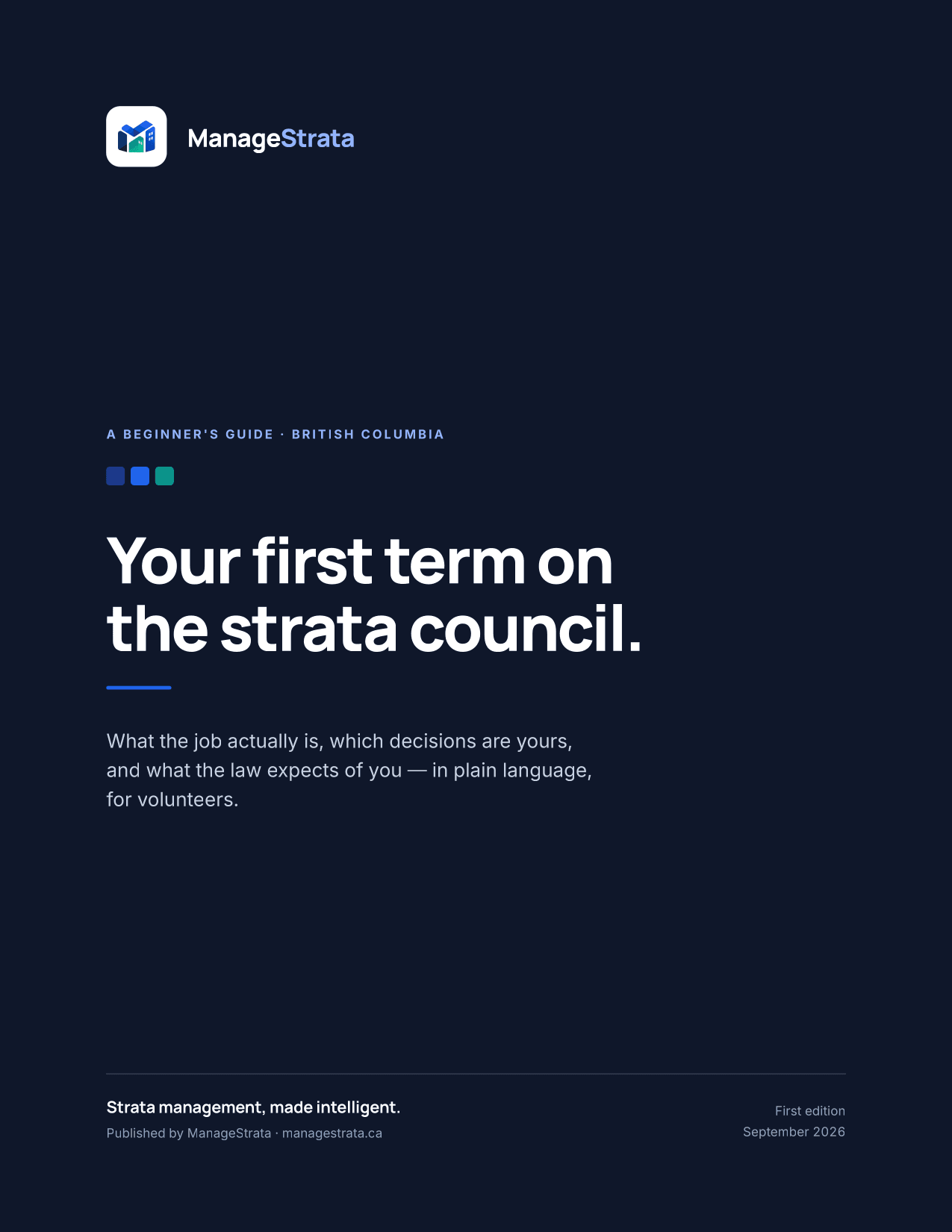
Your first term on the strata council
New to the council, or handing the job to someone who is? Ten short chapters on what a BC council actually does, and the deadlines it can’t miss.
A few notes a year on running a strata
Deadlines that catch councils out, what changed in the rules, and what we shipped. Unsubscribe in one click, any time.
Run your strata with confidence
ManageStrata tracks your compliance deadlines, AGMs, and finances — with AI that drafts the work and you approve it. Free up to 4 lots.
Start free