

Blog · Compliance · 7 min read
Perimeter Drains, Gutters and Sumps: The Water Defences a BC Strata Forgets
ManageStrata Team
November 17, 2026
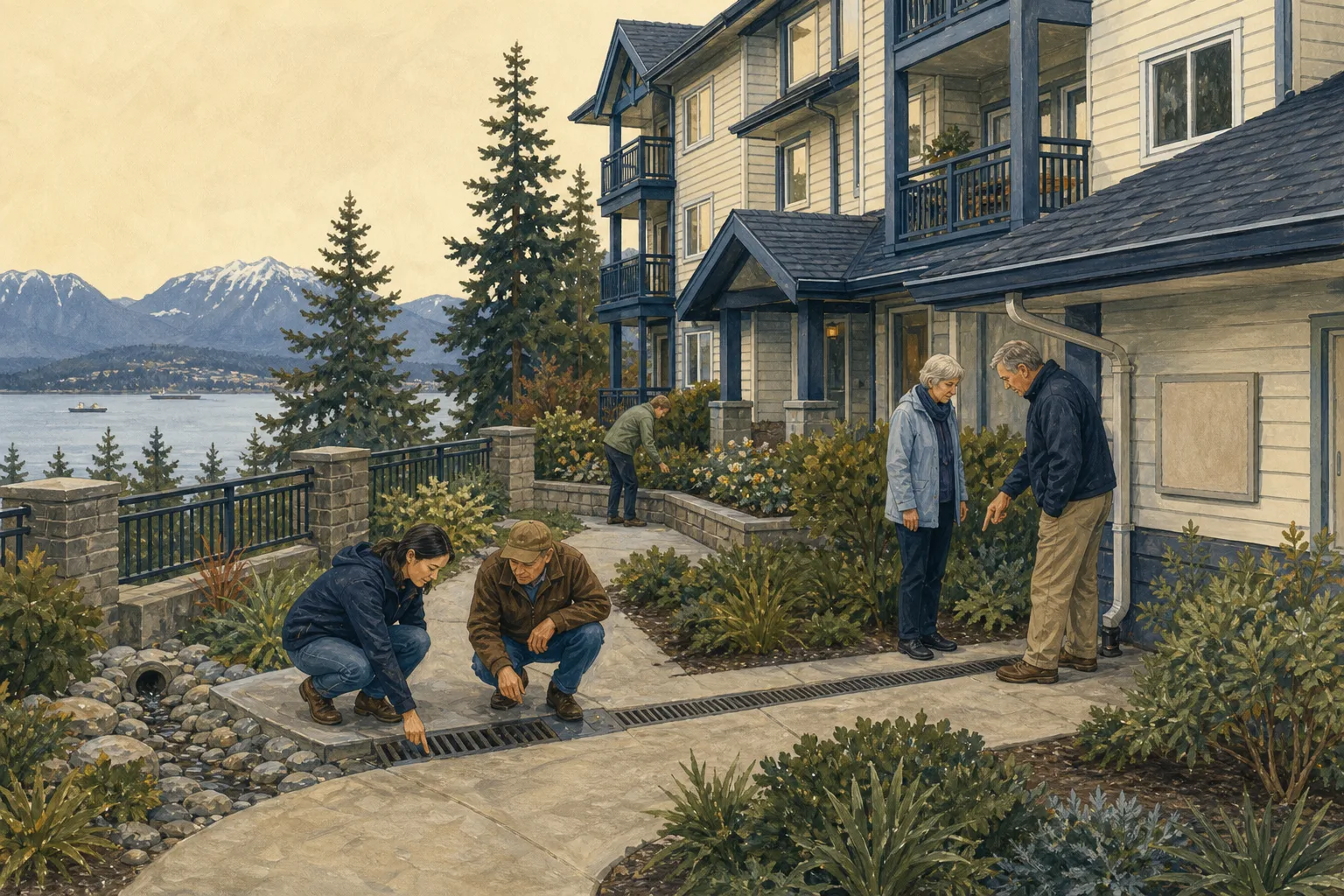
It is the second night of an atmospheric river, and someone is standing in the parkade in a headlamp watching water creep toward the electrical room. The sump pump is running — or it was. Nobody on council can say when it was last serviced, whether the perimeter drains were ever scoped, or which contractor holds the records. The last person who knew left the council two AGMs ago.
The tension here is not water. It is that the building's drainage system has no owner in the minutes: no interval, no file, no line in the budget. This post sets out who is responsible for perimeter drains, gutters and sumps under the Act and the Standard Bylaws, what you can spend without a vote when water is already coming in, and how to get the whole system into a record that outlasts the council.
Drainage is almost always the strata's problem
Start with where ownership stops. Under section 68 of the Strata Property Act, unless the strata plan says otherwise, a strata lot's boundary runs midway through the structural portion of the wall, floor or ceiling. Everything outboard of that — footings, foundation walls, the drain tile wrapped around them — is not inside anyone's lot.
The definition of common property in section 1 goes further: pipes, ducts and other facilities for the passage of water, sewage and drainage are common property where they sit within a boundary wall, floor or ceiling, or where they run wholly or partly within a strata lot but are capable of and intended to be used in connection with another strata lot or the common property. A perimeter drain serving the whole foundation fits that description comfortably.
Section 72 then puts repair and maintenance of common property and common assets on the strata corporation. The corporation may, by bylaw, make an owner responsible for limited common property the owner has a right to use, and may by bylaw take responsibility for specified portions of a strata lot. So the answer to "is this ours?" turns on three documents: the strata plan, the Act, and your own registered bylaws.
The Standard Bylaws fill in the default split. Bylaw 8 requires the strata corporation to repair and maintain common assets, common property that is not limited common property, and limited common property where the work in the ordinary course occurs less often than once a year — plus the structure and exterior of a building no matter how often the work occurs. Bylaw 2 makes an owner responsible for their strata lot and for limited common property they use, except where the corporation is responsible. Many stratas have amended these; read yours rather than the Schedule.
One more useful provision: section 69 creates implied easements for the passage of water and drainage through pipes and facilities in another lot or the common property, and those easements include a right of entry to inspect, maintain, repair and replace them. If a cleanout or a sump sits inside a townhouse's garage, access is not a favour.
Where the water actually gets in
- Perimeter drain tile — silt, root intrusion, crushed sections, a failed filter sock. Invisible until the crawlspace is wet.
- Gutters, downspouts and leaders — the cheapest item on this list and the most common cause of a saturated foundation when a downspout discharges against the wall instead of into the storm connection.
- Catch basins, area drains and trench drains at parkade ramps — the one that matters most in a sustained rain event.
- Sump pits and pumps — float switches, check valves, the alarm nobody tested, and the question of what happens on a power failure.
- Site grading and landscaping — soil built up above the damp-proofing, or a planter draining toward the building.
Ponding at an entry also becomes an access problem, which is worth noting if your building is working through accessibility and the duty to accommodate.
Questions councils ask when the water is already rising
Do we need an owners' vote before we can spend money during a flood? No. Under section 98, a strata corporation may spend from either the operating fund or the contingency reserve fund where there are reasonable grounds to believe an immediate expenditure is necessary to ensure safety or prevent significant loss or damage. Section 98 also allows unapproved operating-fund spending up to the limit in the bylaws, or if the bylaws are silent, the lesser of $2,000 and 5% of the annual operating-fund contribution.
Can we pay for a drain replacement out of the contingency reserve fund without a 3/4 vote? Sometimes. Under section 96, a majority vote is enough where the repair, maintenance or replacement of common property is recommended in the most current depreciation report. Otherwise CRF spending needs a 3/4 vote — at least 3/4 of the votes cast by eligible voters present in person or by proxy who did not abstain, not 3/4 of all owners.
What about a special levy? A special levy needs a 3/4 vote where each lot's share is calculated the usual way under ss. 99, 100 or 195 (normally unit entitlement). If you want to divide it another way that establishes a fair division for that particular levy, section 108 requires a unanimous vote. The resolution must set out the purpose, the total amount, each lot's share and the due dates.
Who pays the insurance deductible? Under section 158, paying a deductible on a claim against the strata's insurance is a common expense contributed through strata fees — and the corporation is not barred from suing an owner who is responsible for the loss to recover it, in which case it is that owner's liability in full, not shared by unit entitlement. Section 158(3) also means no owners' approval is needed for a special levy or CRF expenditure to cover a deductible the strata must pay to repair damaged property, unless it has decided not to repair under s. 159. Whether a particular water event is covered at all is a policy-wording question for your broker; the regulation's list of "major perils" in section 9.1 includes water escape, which is not the same thing as groundwater or surface flooding.
Set an interval, because the law doesn't set one for you
Fire and life-safety systems each carry their own BC Fire Code interval — monthly, annually or otherwise — which is why fire and life-safety inspections more or less schedule themselves. Drainage has no equivalent. The interval comes from the manufacturer, your engineer, your site conditions and your own judgment, recorded as a council decision.
Your depreciation report is the natural home for it. Regulation s. 6.2 requires the physical component inventory to cover building systems, utilities including water and sewage, parking facilities and roadways, and landscaping, with estimated service life and 30-year cost projections. Reports are required for strata corporations of five or more lots, renewed every five years and prepared by a qualified person, with deadlines of July 1, 2026 for Metro Vancouver, the Fraser Valley and the Capital Regional District and July 1, 2027 elsewhere in BC. If drainage is missing from your inventory, that is the gap to close before the next report is commissioned. Pair it with a standing schedule in your maintenance plan and work orders.
What a healthy strata does about it
The costly version of this problem is always the late one. The calm version looks like a short, boring file that any future council can pick up:
- A plan markup showing every catch basin, cleanout, sump and downspout connection, with photos.
- A written interval for gutter clearing, drain flushing and camera inspection, approved in a council minute so it survives a turnover.
- Pump records: make, model, install date, float test dates, alarm test dates, spare on hand or not.
- Scoping video and contractor reports kept with the building file. Reports on repair or maintenance of major items are retained until disposal or replacement under Regulation s. 4.1; depreciation reports are kept permanently.
- The next three years of drainage work named in the budget discussion, so nobody is surprised.
Councils with years of scattered PDFs sometimes run them through a tool like SearchStrata to pull every mention of drainage, sumps or water ingress out of old minutes and engineering reports before rebuilding the file. And because councils and managers both change, keep that record where it belongs: with the corporation. ManageStrata is built on that premise — the documents, minutes, votes and books stay with the strata when the people running it change, and council can export a full copy at any time.
This article is general information about BC strata law, not legal advice; verify against the current Strata Property Act and Regulation or consult a BC strata lawyer.
General information, not legal advice. This article explains British Columbia strata law in general terms. The Strata Property Act and its regulations change over time and apply differently to each strata corporation. Confirm details against the current legislation or consult a qualified strata lawyer before acting.
Frequently asked questions
- Is a perimeter drain common property or the owner's responsibility in a BC strata?
- It depends on the strata plan and your registered bylaws, but drainage serving a building is usually common property. Section 1 of the Act defines common property to include facilities for the passage of drainage located within boundary walls, floors or ceilings, or within a strata lot where they are intended to be used in connection with another lot or the common property. Section 72 puts repair and maintenance of common property on the strata corporation, though the corporation may by bylaw make an owner responsible for limited common property the owner uses.
- Can a strata council pay for emergency flood work without an owners' vote?
- Yes, within limits. Section 98 of the Strata Property Act permits spending from either the operating fund or the contingency reserve fund where there are reasonable grounds to believe an immediate expenditure is necessary to ensure safety or prevent significant loss or damage. Section 98 also allows unapproved operating-fund spending up to the limit set in the bylaws, or if the bylaws are silent, the lesser of $2,000 and 5% of the annual operating-fund contribution. Non-emergency CRF spending generally needs a 3/4 vote, unless it falls into one of the majority-vote cases in section 96, such as work recommended in the most current depreciation report.
- How often should a strata inspect sump pumps and perimeter drains?
- There is no interval set by the Strata Property Act or the Regulation for drainage, unlike fire and life-safety systems, which each carry their own BC Fire Code interval. The schedule comes from manufacturer guidance, an engineer's advice and your site conditions — soil type, tree cover, slope and age of the building. The practical approach is to have council adopt a written interval in a minute, record each test and cleaning, and make sure drainage components appear in the depreciation report's component inventory under Regulation s. 6.2.
Keep reading

Free guide · 18 pages
Your first term on the strata council
New to the council, or handing the job to someone who is? Ten short chapters on what a BC council actually does, and the deadlines it can’t miss.
A few notes a year on running a strata
Deadlines that catch councils out, what changed in the rules, and what we shipped. Unsubscribe in one click, any time.
Run your strata with confidence
ManageStrata tracks your compliance deadlines, AGMs, and finances — with AI that drafts the work and you approve it. Self-managed or with a manager, the record stays with your corporation. Free up to 4 lots.
Start free