

Blog · Finance · 7 min read
Signs of a Healthy Strata Before You Buy in BC
ManageStrata Team
November 6, 2026

You get the document package three days before subject removal: a Form B, a budget, some minutes, a stack of bylaws. You skim it, nothing is on fire, and you sign. Eight months later a special levy notice arrives for a building envelope repair that, it turns out, was discussed in council minutes two years ago.
The tension in almost every strata purchase is the same: the information that would have told you what you were buying existed, but it wasn't in front of you in time, or it wasn't written down in a way you could read. This post covers what the Act actually entitles you to see, what the documents reveal when you read them in the right order, and which patterns are genuine warning signs rather than cosmetic ones.
Start with what you are legally entitled to receive
A Form B Information Certificate is the backbone of the package. Under section 59 it must be provided within one week of a request by an owner, purchaser, or someone either of them authorises, for a maximum fee of $35 plus reproduction costs of up to 25 cents per page under Regulation s.4.4.
Form B has exactly three required attachments: the rules, the current budget, and the most recent depreciation report obtained under s.94, if there is one. Bylaws, financial statements and minutes are not Form B attachments — those are separately requested records under section 36, which the strata must make available within two weeks (one week for bylaws and rules).
Some attachments appear only where the answer to a question is yes, and these are the ones worth hunting for:
- bylaw amendments not yet filed in the land title office
- resolutions required to be filed but not yet filed
- details of court, arbitration or tribunal proceedings, judgments or orders
- notices or work orders received
- parking allocation documents and electrical planning reports
- a summary of the strata's insurance coverage
Note the quiet distinction: the bylaws themselves are not attached, but unfiled bylaw amendments are. That matters because a bylaw amendment has no effect until it is filed in the Land Title Office under section 128(2). An unfiled amendment tells you what the owners want the rules to be — not what they are.
You will also see a Form F Certificate of Payment, due within one week, maximum fee $15. It is current for 60 days for the purposes of section 256, which is why a transfer cannot be registered without a current one.
The money questions: what the numbers tell you
Strata fees are set by the budget, which owners approve by majority vote under section 103, and each lot's share is calculated by unit entitlement — the figure in the Schedule of Unit Entitlement filed with the strata plan (Form V), not by the bylaws and not simply by floor area. Our guides to how strata fees work in BC and preparing a strata annual budget walk through the mechanics.
Since November 1, 2023, every strata corporation and section must budget a minimum annual contingency reserve fund contribution of at least 10% of the total budgeted operating fund contribution, determined after considering the most recent depreciation report (Regulation ss.3.4 and 6.1). The older rule that no contribution was needed once the CRF hit 25% of the operating budget no longer applies. If a seller's agent tells you the fund is "fully funded," that is not a thing the Regulation recognises. Read our CRF guide for how the fund is spent and what votes are needed.
Ask yourself:
- Are low fees paired with a thin CRF and a long list of deferred work?
- Does the depreciation report's funding model match what the budget actually contributes?
- Has the strata relied repeatedly on special levies instead of contributions?
Q&A: the questions buyers actually ask
Is a depreciation report required? Yes, for strata corporations of 5+ lots — the 3/4-vote waiver was removed. The deadline is July 1, 2026 for Metro Vancouver, the Fraser Valley and the Capital Regional District, and July 1, 2027 elsewhere in BC, with renewal every five years by a qualified person. A strata with no report and a near deadline is a timing question, not automatically a red flag.
What about EV readiness? An electrical planning report is required for 5+ lot stratas by December 31, 2026 in those same regions, or December 31, 2028 elsewhere. Under 5 lots, an EV-charging approval process is needed by December 31, 2026.
Does the strata policy cover my unit? Largely, yes. Under section 149 the corporation must insure common property, common assets, buildings shown on the strata plan, and owner-developer original fixtures, on a full-replacement-value basis. You insure the rest — improvements, non-original fixtures, betterments, loss of use and liability — under section 161. Check the deductible: the strata must review its insurance annually, report at each AGM, and inform owners of any material change including a deductible increase (s.154).
Can I renovate after I move in? It depends on what you're touching and on the strata's own registered bylaws. Standard Bylaw 5 requires written approval before altering a strata lot in listed ways — structure, exterior, balconies, exterior-facing doors and windows, common property inside the lot, and the parts the corporation must insure under s.149 — and approval must not be unreasonably withheld. Standard Bylaw 6 covers common property and limited common property. Approval is given in writing by the strata corporation, in practice by council — never by a majority vote of owners. Many bylaws go further than the Schedule, so read the registered set.
Red flags that are actually red
- Minutes that skip meetings or record no discussion. Minutes of general and council meetings must be kept at least six years under Regulation s.4.1; a gap is a governance signal.
- Engineering reports referenced but never produced. Reports on repair or maintenance of major items are kept until disposal or replacement.
- Litigation or work orders disclosed on Form B with no explanation in the minutes.
- Repeated emergency spending. Section 98 lets a strata spend without approval where there are reasonable grounds to believe an immediate expenditure is necessary for safety or to prevent significant loss or damage. Once is maintenance. A pattern is deferral.
- Fire and life-safety records that don't exist. Alarms, sprinklers, extinguishers, emergency lighting and standpipes each have their own BC Fire Code interval, and keeping them serviced is part of the duty to repair and maintain common property under section 72. There is no single "annual fire inspection" of a whole building.
If the package runs to hundreds of pages, tools like SearchStrata can help surface the themes across years of minutes before you read closely.
What a healthy strata does about it
A healthy strata is open by default. The same facts sit in front of owners, council and purchasers, and nobody needs an insider to find them. In practice that looks like: minutes that record what was decided and why; a depreciation report the budget visibly responds to; alteration approvals captured in writing with the owner's agreement to take responsibility for the expenses relating to the alteration; and a records set that is complete enough that a Form B request is routine rather than a scramble.
It also means the record belongs to the corporation. Councils turn over, managers change, and there is no requirement under the Act to hire one at all — any strata may be self-managed. ManageStrata is built on that idea: the documents, minutes, votes and books stay with the strata when the people running it change, and council can export a full copy at any time. When you are the buyer, the building where that is already true is the one whose documents tell you the truth.
This article is general information about BC strata law, not legal advice; verify against the current Strata Property Act and Regulation or consult a BC strata lawyer.
General information, not legal advice. This article explains British Columbia strata law in general terms. The Strata Property Act and its regulations change over time and apply differently to each strata corporation. Confirm details against the current legislation or consult a qualified strata lawyer before acting.
Frequently asked questions
- What strata documents should I review before buying in BC?
- At minimum: the Form B Information Certificate with its three required attachments (rules, current budget, most recent depreciation report obtained under s.94), plus the registered bylaws, two years of council and general meeting minutes, financial statements, the depreciation report in full, the insurance summary, and any conditional Form B attachments such as unfiled bylaw amendments, work orders, or details of court, arbitration or tribunal proceedings. Bylaws, minutes and financials are requested separately under s.36, which the strata must satisfy within two weeks (one week for bylaws and rules).
- How quickly must a strata corporation provide a Form B and Form F?
- Both are due within one week of the request. A Form B must be given within one week of a request by an owner, purchaser or someone authorised by either, for a maximum fee of $35 plus reproduction costs of up to 25 cents per page. A Form F Certificate of Payment must be given within one week where the owner owes nothing, or the money is paid into court or held in trust, or satisfactory payment arrangements have been made, for a maximum fee of $15. A Form F is current for 60 days for the purposes of s.256.
- Is a low contingency reserve fund a red flag when buying a strata?
- It can be, but read it alongside the depreciation report and the budget rather than on its own. Since November 1, 2023 every strata corporation and section must budget a minimum annual CRF contribution of at least 10% of the total budgeted operating fund contribution, determined after considering the most recent depreciation report. The sharper question is whether the budget's contributions match the report's projected costs and timing, and whether the strata has been relying on special levies in place of regular contributions.
Keep reading
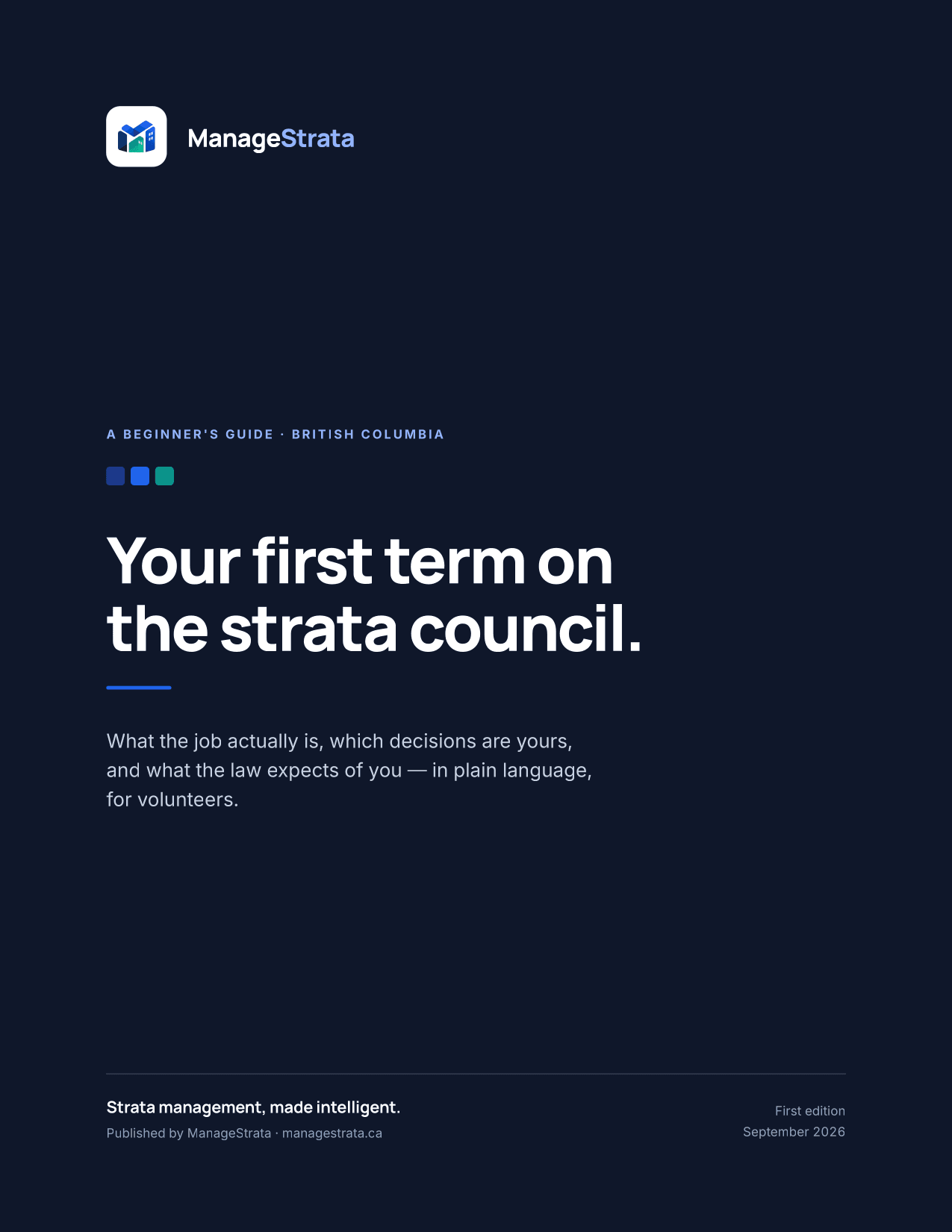
Free guide · 18 pages
Your first term on the strata council
New to the council, or handing the job to someone who is? Ten short chapters on what a BC council actually does, and the deadlines it can’t miss.
A few notes a year on running a strata
Deadlines that catch councils out, what changed in the rules, and what we shipped. Unsubscribe in one click, any time.
Run your strata with confidence
ManageStrata tracks your compliance deadlines, AGMs, and finances — with AI that drafts the work and you approve it. Self-managed or with a manager, the record stays with your corporation. Free up to 4 lots.
Start free