

Blog · Governance · 6 min read
Conflict of Interest Rules for Strata Council
ManageStrata Team
July 20, 2026

Strata councils in British Columbia make decisions that move real money — awarding a landscaping contract, approving an alteration, hiring a manager, deciding whether to fine an owner. When a council member has a personal stake in one of those decisions, the Strata Property Act sets out a specific, mandatory process. It is short, it is clear, and it is one of the most commonly overlooked provisions in strata governance.
What the Act actually requires
Section 32 of the Strata Property Act applies to a council member who has a direct or indirect interest in:
- a contract or transaction with the strata corporation, or
- a matter that is or is to be the subject of consideration by the council, if that interest could result in the creation of a duty or interest that materially conflicts with that member's duty or interest as a council member.
Where it applies, the council member must do three things:
- Disclose fully and promptly to the council the nature and extent of the interest;
- Abstain from voting on the contract, transaction or matter; and
- Leave the council meeting while the matter is discussed — unless council asks them to stay to provide information — and while council votes on it.
All three are required. Disclosing and then staying in the room to argue for your preferred outcome does not satisfy s.32. Note the narrow exception: council may ask the member to remain to provide information, but the member still cannot vote, and there is no exception to leaving for the vote itself.
Direct, indirect, and "materially conflicts"
The Act does not define these terms or give examples, so applying them is a judgment call on the facts. Some situations are obvious: a council member whose own company is bidding on the roof replacement, or whose spouse owns the cleaning contractor. Others are genuinely arguable — a member who lives directly beneath the strata lot whose renovation is under review, for example.
Two practical points:
- The trigger for the second branch is materiality. For a matter under consideration, s.32 engages where the interest could create a duty or interest that materially conflicts with the member's duties as a council member. Not every shared interest with other owners is a conflict — every council member pays strata fees.
- When in doubt, disclose. Disclosure costs nothing and is recorded in the minutes. A decision later attacked as tainted is far more expensive than an unnecessary abstention.
Some strata corporations adopt their own registered bylaws that go further than s.32 — requiring written declarations, an annual conflict register, or restrictions on council members bidding on work. Whether your strata has anything like that depends entirely on its own registered bylaws, so read them rather than assuming the Standard Bylaws are the whole picture. If you are digging through years of filed bylaws and minutes to find out, tools like SearchStrata can run AI analysis across strata documents to surface the relevant provisions quickly.
Questions and answers
Q: Does the conflicted member still count toward quorum?
A: Standard Bylaw 16 in the Schedule of Standard Bylaws sets quorum by council size and requires members to be present in person to be counted in establishing quorum. Because s.32 requires the conflicted member to leave while the matter is discussed and voted on, a small council can lose quorum for that item. Councils in that position often defer the item, or the strata corporation deals with it at a general meeting. Your own bylaws may have amended the quorum rule, so check them.
Q: How are council votes counted once someone abstains and leaves?
A: Under Standard Bylaw 18, council decisions are made by a majority of council members present in person at the meeting, and the results of all votes must be recorded in the council meeting minutes. Unless there are only two strata lots, the president may break a tie with a second, deciding vote.
Q: What if the complaint is about a council member?
A: Section 136 of the Act says that if a complaint is made about a council member contravening a bylaw or rule, that member must not participate in the decision made under s.135 about the complaint — unless all the owners are on the council. Section 135 still applies in full: written particulars of the complaint, a reasonable opportunity to answer including a hearing if requested, and written notice of the decision as soon as feasible.
Q: Can owners overrule a council decision they think was tainted?
A: Not directly, and not by "appealing" it at a general meeting — there is no such right in the Act. What owners can do is direct or restrict the council by a majority vote at an annual or special general meeting under s.27, except where the direction would be contrary to the Act, regulations or bylaws, or would interfere with council's discretion on the facts of a particular case (including whether someone contravened a bylaw, whether to fine, the amount, denial of recreational facility access, or requiring payment of remedying costs under s.133(2)). Owners may also remove one or more council members by majority vote at a general meeting under Standard Bylaw 11 — unless all owners are on the council — and must then hold an election at that same meeting to fill the remainder of the term. An individual owner or tenant can also request a hearing at a council meeting under s.34.1; council must hold it within 4 weeks, and where the purpose is to seek a decision, give a written decision within one week of the hearing. Beyond that, the routes are the Civil Resolution Tribunal or the courts.
Delegation is not a workaround
Councils sometimes try to route a conflicted decision around the problem by delegating it. Standard Bylaw 20 permits council to delegate powers and duties to council members or non-members, but spending powers only by a resolution that either authorises a specific amount for a specific purpose or sets a maximum amount plus the purposes or conditions. Critically, council cannot delegate its powers to determine, on the facts of a case, whether a person contravened a bylaw or rule, whether they should be fined and in what amount, or whether they should be denied access to a recreational facility.
Good habits for self-managed councils
- Put a standing "declarations of interest" item at the top of every council agenda.
- Record in the minutes who disclosed, what the interest was, that they abstained, and that they left the room.
- Get more than one quote on significant contracts — it is the cleanest defence to a conflict allegation. The same discipline applies when choosing a strata management company.
- Where the decision has to go to owners instead, make sure the general meeting is properly called; see BC Strata AGM Notice & Quorum Requirements and, for remote participation, Electronic Voting at BC Strata Meetings.
Self-managed councils carry these duties themselves, and clean records are what make them defensible — a purpose-built platform such as ManageStrata helps keep minutes, disclosures and vote results in one place.
This article is general information about BC strata law, not legal advice; verify against the current Strata Property Act and Regulation or consult a BC strata lawyer.
General information, not legal advice. This article explains British Columbia strata law in general terms. The Strata Property Act and its regulations change over time and apply differently to each strata corporation. Confirm details against the current legislation or consult a qualified strata lawyer before acting.
Frequently asked questions
- What exactly must a strata council member do if they have a conflict of interest?
- Under s.32 of the Strata Property Act, a council member with a direct or indirect interest in a contract or transaction with the strata corporation — or in a matter before council where that interest could materially conflict with their duties as a council member — must disclose the nature and extent of the interest fully and promptly to council, abstain from voting, and leave the meeting while the matter is discussed and voted on. Council may ask them to stay to provide information during the discussion, but not for the vote.
- Can a council member vote on a fine against themselves?
- No. Section 136 provides that if a complaint is made about a council member contravening a bylaw or rule, that member must not participate in the decision made under s.135 about the complaint. The only stated exception is where all the owners are on the council. The full s.135 process still applies: written particulars, a reasonable opportunity to answer including a hearing if requested, and written notice of the decision as soon as feasible.
- If a conflicted member leaves and council loses quorum, what happens?
- The Act does not create a special quorum rule for conflicts. Standard Bylaw 16 sets quorum by council size and requires members to be present in person to be counted. If the departure of a conflicted member leaves council short, council cannot validly decide that item at that meeting; common approaches are to defer it, or for the strata corporation to address it at a general meeting. Check your strata's registered bylaws, which may have amended the standard quorum provision.
Keep reading
Free guide · 18 pages
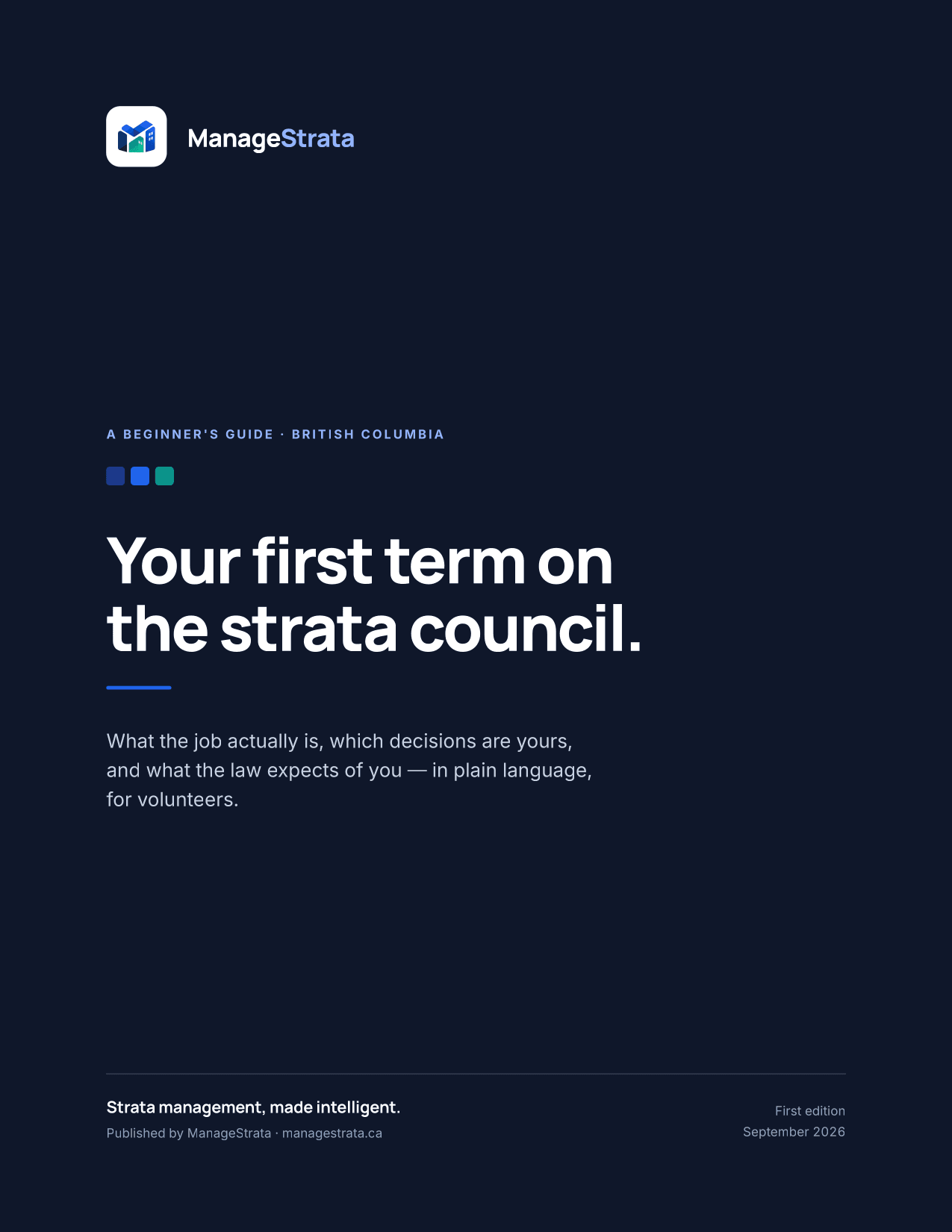
Your first term on the strata council
New to the council, or handing the job to someone who is? Ten short chapters on what a BC council actually does, and the deadlines it can’t miss.
A few notes a year on running a strata
Deadlines that catch councils out, what changed in the rules, and what we shipped. Unsubscribe in one click, any time.
Run your strata with confidence
ManageStrata tracks your compliance deadlines, AGMs, and finances — with AI that drafts the work and you approve it. Free up to 4 lots.
Start free